
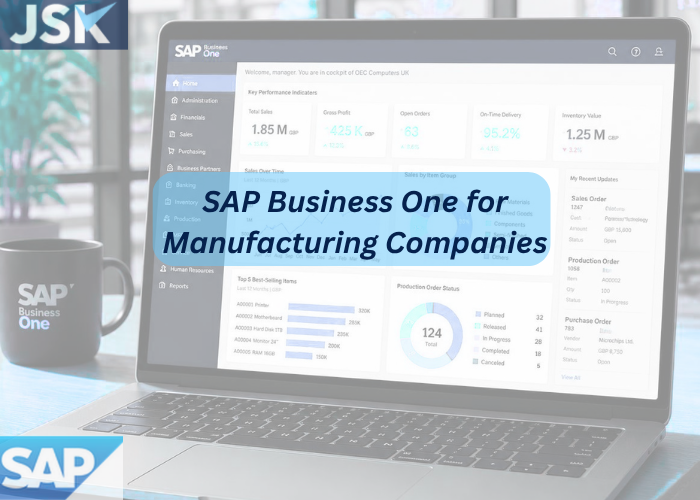
SAP Business One provides a connected view of production, inventory and financial performance.
Introduction
When growth exposes the limits of spreadsheets and disconnected software, the answer is not more reconciliation. It is better operational visibility. SAP Business One for Manufacturing Companies helps manufacturers replace manual processes with an integrated Manufacturing ERP that connects production planning, inventory management, purchasing, warehouse operations, and finance. Instead of spending hours reconciling data, businesses gain real-time visibility into production, inventory, and financial performance, enabling faster and more informed decisions.
The Monday-morning question most factories cannot answer quickly
A customer asks for an earlier delivery date. Sales wants to agree, production sees spare capacity, stores is unsure whether critical components are reserved, and purchasing can source them only at a premium. Finance cannot confirm whether the expedited order will still earn an acceptable margin. Four teams have four versions of the answer.
This is the point at which disconnected tools become expensive. The cost is not limited to time spent reconciling spreadsheets. It appears as avoidable buying, idle work centres, missed commitments and margin discovered too late. SAP Business One for Manufacturing Companies gives the commercial and operational teams a shared transaction trail, so an order can be considered together with material availability, purchasing commitments, production activity and its financial consequence.
Think of Enterprise Resource Planning (ERP) as a chain of evidence
For a Chartered Accountant, a reliable number needs a reliable path behind it. Factory data is no different. Finished goods should connect to material issues and production receipts; a liability to its order and receipt; a sales margin to its commercial and cost inputs. SAP Business One links these events inside one system for small and midsize organisations.
The discussion can then move from which spreadsheet is current to the exception that needs action: a shortage, unusual consumption, a late supplier or a price variance. A manufacturing ERP is valuable when it shortens the distance between an event and a responsible decision.
Three control loops that matter in manufacturing
1. Demand, material and production
A confirmed requirement should lead to a practical check. What can be supplied from stock, what must be produced and what has to be purchased? Bills of materials, production orders and material requirements planning provide the structure for that check. This is how SAP Business One improves production planning. It gives planners a consistent basis for discussing quantities and dates rather than relying on memory or isolated files. Production planning software does not remove uncertainty, but it makes assumptions visible enough to challenge.
2. Physical stock and recorded stock
A system balance is useful only when the factory trusts it. SAP Business One inventory management for manufacturers provides a warehouse-level trail of incoming stock, material consumption, internal movements and quantities already reserved for open demand. The harder work is deciding who posts each movement and how exceptions are corrected. An inventory management ERP should expose weak discipline, not hide it.
3. Output, cost and commercial margin
Finance should not have to wait until period-end to identify an adverse production pattern. SAP Business One financial reporting for manufacturers can bring purchasing, inventory, sales, receivables and payables into the same reporting environment. That allows the CFO to examine questions with operating context: Is margin erosion caused by price, material consumption, urgent freight or product mix? Which customers absorb working capital?
Why a Chartered Accountant (CA) led implementation sees different risks
Software demonstrations often follow a perfect transaction. Real factories do not. Materials arrive short, substitutes are approved, batches fail inspection, customers change quantities and employees discover workarounds. A Chartered Accountant-led SAP Business One implementation looks beyond the happy path. It asks how an exception is authorised, recorded, valued and reported, who can change master data, and whether the final management report can be reconciled without an unofficial spreadsheet.
At Krijay Technologies, that perspective shapes discovery for the manufacturing industry. We map the movement of goods and the movement of value together. The aim is not to reproduce every historic habit in new software. It is to retain the controls that matter, remove duplicate effort and define a cleaner responsibility for data. A CA-led review is especially useful when owners want growth without losing visibility over cash, inventory and profit.
What should a useful manufacturing dashboard provoke?
A dashboard succeeds when somebody acts sooner. A plant head may need shortages and delayed orders, a finance head may need inventory ageing, purchase commitments and margin exceptions. The platform can provide a common reporting base while giving each role the view it owns.
Begin with questions, not colours. Which late orders need escalation? Which items have stock but no recent movement? Which purchase requests exceed a limit? Review exceptions at a fixed cadence and name an owner. That is more valuable than treating ERP software for factory management as a passive archive.
A fit test before you choose the system
SAP Business One for manufacturing SMEs is worth evaluating when order volume, warehouses, product structures or reporting expectations have outgrown informal coordination. The trigger is usually complexity, not headcount. An inventory management ERP becomes relevant when warning signs include frequent stock corrections, shortages despite high inventory, delayed closes, unclear product economics and decisions that depend on one employee assembling several files.
When comparing the best ERP software for manufacturing SMEs, insist on a scenario-based demonstration. Test a sales-order change, partial receipt, production issue, warehouse transfer and rejected component. The demonstration should reveal how information travels and where approval is required. A polished menu matters less than a convincing answer to a messy event. Review relevant implementation case studies to see how similar operational problems are framed.
Implementation decisions that prevent a second spreadsheet system
Any practical manufacturing ERP implementation guide should give master data equal attention to configuration. Assign ownership for item codes, units, warehouses, vendors and bills of materials. Document costing assumptions and approval limits, clean migration data, and test complete business cycles with the people who perform them.
While selecting an SAP Business One implementation partner for manufacturers, ask who will challenge process gaps, who signs off reconciliations and how support will work after launch. Avoid unnecessary customisation unless the business case is clear. Production planning software earns trust through accurate inputs, understood rules and consistent use; no configuration can compensate for unclear ownership.
Frequently asked questions
Is SAP Business One appropriate for a smaller factory?
It is intended for small and midsize businesses, but suitability depends on the factory's processes, reporting needs, integrations, local requirements and any specialist add-ons. A discovery exercise should confirm fit before a proposal is finalised.
Does it support bills of materials and production orders?
Yes. Those capabilities can provide a structured record of what is planned and what is produced. Companies needing advanced scheduling, quality management or shop-floor functionality should test the relevant standard features and add-ons against real use cases.
What about GST-related requirements?
SAP Business One for manufacturing companies in India can be configured for applicable local financial and tax processes using the relevant localisation and updates. The exact design should be reviewed by qualified tax and implementation professionals for the company's facts.
How should a company estimate the implementation period?
Estimate it after discovery. Data condition, locations, integrations, add-ons, process redesign, testing and user availability can all change the schedule. A credible plan explains dependencies and acceptance criteria instead of promising a universal duration.
A better first step than requesting a generic quotation
SAP Business One for Manufacturing Companies should be evaluated against the decisions your factory struggles to make today. Choose one important order flow, follow it from demand to cash and note every manual handoff, duplicate entry and reconciliation. That small exercise usually reveals where visibility is being lost and what an ERP project must genuinely improve.
Krijay Technologies offers Chartered Accountant-led SAP consulting for manufacturers that want a financially grounded assessment before committing to software. Begin with a focused discovery conversation covering inventory reliability, production information, reporting and control. You will leave with a clearer problem statement, a prioritised scope and practical next steps for an ERP programme.
Ready for a clearer view of your factory?
Book an ERP discovery session with Krijay Technologies.