
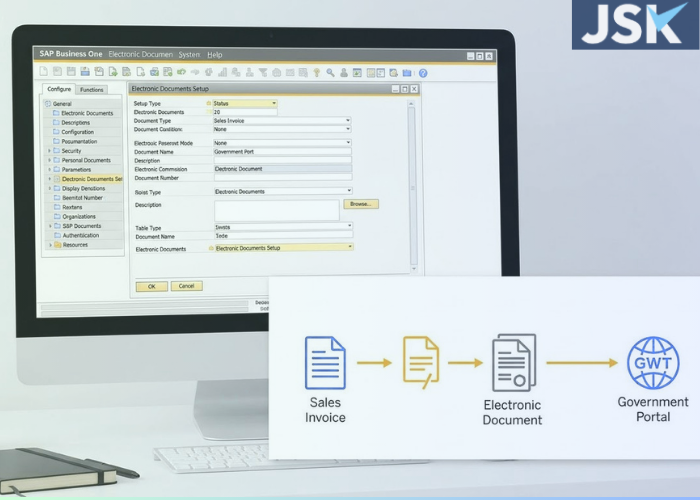
An integrated SAP Business One workflow can move invoice data through electronic document validation and onward to the government portal.
Introduction
Scaling an enterprise in India demands a profound shift in how financial operations are managed. As growing businesses hit the limits of legacy accounting software, the shift to an enterprise-grade ERP system becomes inevitable. However, this transition is rarely just an IT upgrade; it is a fundamental financial restructuring. At the core of this transformation is the need to master GST compliance and e-invoicing in SAP Business One.
For companies handling thousands of transactions, manual tax reconciliation is no longer viable. Implementing GST compliance and e-invoicing in SAP Business One correctly from day one can determine whether the ERP becomes an engine for growth or a source of continuous regulatory anxiety.
Many enterprise decision-makers assume that moving to a top-tier ERP automatically resolves taxation challenges. In reality, while SAP provides a robust structural foundation, adapting it to the rules of the Indian tax system requires specialised architectural planning. Effective GST compliance and e-invoicing in SAP Business One means moving beyond basic data entry to establish automated financial controls that protect the company's bottom line.
The Hidden Risks of Standard IT Implementations
The most significant barrier to effective GST compliance and e-invoicing in SAP Business One stems from treating the implementation as a pure technology project. Standard IT-only migrations frequently fail to grasp the nuanced financial logic required for the Indian market. When technology consultants map legacy data without a deep understanding of tax structures, the resulting post-go-live operational data is often littered with validation errors.
Tally's flexible, open-ledger environment allows retrospective adjustments, whereas the SAP Business One data model enforces controlled audit trails. If business partner master data is migrated without rigorous cleansing, or if tax codes are improperly assigned, companies may face rejected invoices on the government portal. Attempting to build automation on a corrupted foundational architecture can lead to delayed go-lives, disrupted supply chains, and costly SAP system reviews and support.
True financial integrity requires a proactive stance. Organisations must align their configurations with applicable Goods and Services Tax Council guidelines, ensuring every item master includes accurately mapped HSN codes and appropriate tax-rate categories. Without this groundwork, reliable automation remains out of reach.
The Blueprint for Zero-Defect Automation
To reduce manual intervention and support real-time statutory compliance, companies need a structured integration strategy. GST compliance and e-invoicing in SAP Business One rely on several critical pillars that transform transaction data into validated documents with minimal user friction.
Direct API Integration and the GSP Workflow
The backbone of GST compliance and e-invoicing in SAP Business One is a direct connection to the government's Invoice Registration Portal (IRP). Rather than downloading spreadsheets and uploading them to third-party portals, modern deployments use GST Suvidha Provider API integration. When a user saves a sales invoice in SAP, the system transmits the required payload to the IRP.
This integration enables the system to retrieve the invoice reference number (IRN) and embed the signed QR code on the outbound invoice document. SAP Business One GST e-invoicing automation reduces the invoicing cycle time and supports applicable B2B e-invoicing requirements without unnecessary administrative overhead.
Comprehensive Tax Reconciliation Frameworks
GST compliance and e-invoicing extend beyond outbound billing; they also require rigorous oversight of inward supplies. Manual input tax credit reconciliation is a drain on finance teams and can result in unclaimed credits. By configuring automated ITC workflows within SAP, organisations can monitor vendor uploads and reconcile purchase registers against GSTR-2B data.
The system must also handle scenarios such as reverse-charge mechanisms and SEZ transactions. When the solution is architected correctly, it can support GSTR-1 and GSTR-3B preparation while giving CFOs an accurate view of the electronic credit and cash-ledger position before filings are approved.
Unified E-Way Bill Generation
Logistics and taxation are closely linked in the Indian regulatory landscape. A comprehensive approach integrates e-way bill generation from SAP directly into the delivery workflow. The system uses the same validated transactional data to generate the required e-way bill details, helping prevent physical shipments from being delayed by administrative bottlenecks.
Why a Finance-First Approach Is Non-Negotiable
The complexity of bridging legacy accounting software with enterprise ERP realities highlights why a standard technical deployment is insufficient. GST compliance and e-invoicing in SAP Business One require a deep understanding of financial reporting continuity.
A CA-led ERP implementation partner approaches the configuration from a trial-balance perspective. Before Data Transfer Workbench validations are executed, financial experts ensure the transition will harmonise the chart of accounts and preserve historical accuracy. This finance-first methodology helps prevent data loss during cutover while ensuring the new system enforces appropriate business-process controls.
Integrating Virtual CFO services can also help leadership teams maintain visibility during the transition. Although historical transactional reports cannot simply be copied into SAP's relational tables, businesses can maintain MIS reporting continuity through automated exception reporting and connected intelligence dashboards. This allows compliance automation to become a foundation for broader financial intelligence rather than merely a regulatory checkbox.
Securing Your Financial Future
Successfully transitioning from Tally to SAP S/4HANA or SAP Business One is a major milestone for any enterprise. The success of the transition depends heavily on how effectively the system handles the nuances of Indian taxation. GST compliance and e-invoicing are not merely IT objectives; they are essential to business continuity.
Krijay specialises in bridging technical infrastructure and corporate finance. As a CA-led ERP implementation partner, we design and deploy SAP environments around financial accuracy, controlled migration, and Indian tax requirements. Combined with strategic Virtual CFO services, this approach helps enterprises meet regulatory obligations and use financial data to support sustainable growth.
Discuss GST and e-invoicing automation
Frequently Asked Questions
What is the biggest challenge in achieving GST compliance and e-invoicing in SAP Business One?
The primary hurdle is the gap between unstructured legacy data and SAP's strict relational requirements. Attempting a big-bang cutover without cleansing vendor GSTINs and harmonising tax ledgers can cause automated transactions to be rejected and disrupt the supply chain.
How does a CA-led approach differ from a standard IT deployment for tax automation?
A CA-led implementation evaluates the system architecture against tax logic and accounting standards, not just technical connectivity. By prioritising financial reconciliation and mock migrations, finance experts help ensure the solution produces accurate GST returns and reconcilable ledger balances from day one.
Can we retain historical tax data when migrating to SAP?
Yes. Although flexible legacy entries cannot simply be loaded into SAP's structured data model, a controlled migration can accurately map opening balances and preserve approved historical information. Connected intelligence tools or a governed archive can keep older data available for comparative analysis.
Does automating these processes increase the overall ERP migration cost in India?
Specialised API integrations require an initial investment, but automating GST compliance and e-invoicing can reduce long-term operational effort and risk. The cost should be evaluated against potential penalties, lost input tax credit, processing delays, and emergency remediation caused by an inadequate implementation.