
Introduction
Operating an enterprise on an ageing software foundation is like running high-speed freight trains on brittle timber tracks. When global corporations rely on legacy database designs, routine reporting strains computational limits, monthly financial closings turn into weeks of frantic adjustments, and manual verifications slow down daily operations.
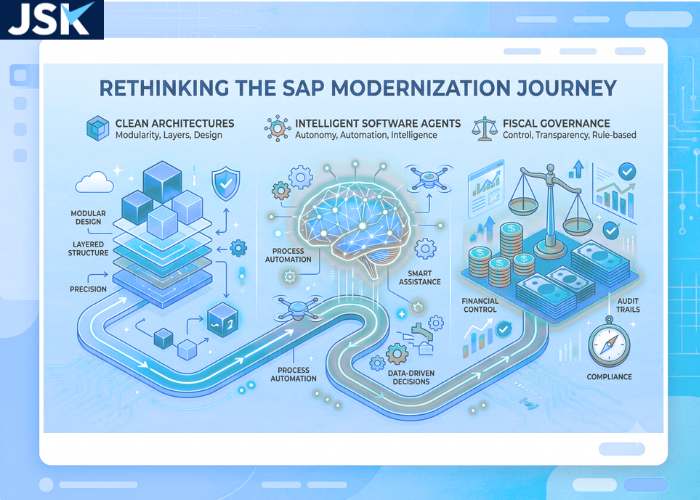
Modernizing your enterprise systems through SAP S/4HANA is fundamentally an operational reset rather than a routine infrastructure patch. Success requires untangling years of accumulated technical workarounds, automating repetitive transactional work with goal-directed software agents, and locking down balance sheet integrity before a single live transaction crosses over.
Without hands-on accounting guidance throughout data migration, even technically successful deployments frequently end in unreconciled intercompany balances, miscalculated statutory obligations, and chaotic reporting cycles.
What Forces Multinational Firms Away from Legacy Systems?
The decision to transition off legacy enterprise architectures stems from four structural operational realities:
- The Compounding Cost of Technical Debt: Legacy deployments typically carry decades of custom modifications, unmonitored script libraries, and ad-hoc Z-tables. Maintaining this patchwork strains engineering bandwidth and blocks compatibility with modern cloud services.
- Delayed Executive Visibility: Older relational databases process complex ledger updates in scheduled overnight batches. Decision-makers must wait days after operational cycles close to review consolidated global margins.
- Escalating Audit Scrutiny Across Borders: International operations require unalterable data lineage. Whether documenting pharmaceutical manufacturing parameters under Title 21 CFR Part 11 standards or filing live digital tax invoices, legacy architectures struggle to guarantee tamper-proof audit trails.
- The AI Readiness Imperative: Modern operational software agents depend on clean, real-time data streaming through standardized interfaces. Messy legacy data models disrupt automated workflows before they can deliver value.
Strategic Architecture: Clean-Core Rebuild or In-Place Conversion?
The central strategic question in enterprise modernization is whether to wipe the operational slate clean or remediate existing database schemas in place.
1. The Clean-Core Rebuild (Greenfield Route)
This methodology deploys an unencumbered environment from scratch. Teams migrate strictly verified active master records and opening balances, abandoning obsolete historical tables.
Ideal Candidates: Organizations with decades of unmanaged modifications, duplicate vendor accounts across territories, or an outdated Chart of Accounts that no longer reflects modern corporate structures.
The Core Benefit: The business adopts standardized best practices, completely restructures financial reporting hierarchies, and establishes an upgrade-safe architecture.
The Strategic Trade-Off: Completed transaction records, old manufacturing batch logs, and historical accounts cannot simply be transferred over; they must be stored in secure, read-only audit repositories to meet legal retention requirements.
2. The In-Place Conversion (Brownfield Route)
This path updates the active database engine under your current installation, retaining all historical logs, established transaction journals, and existing configuration parameters.
Ideal Candidates: Businesses with disciplined master data management, minimal custom code, and operations that depend on constant live access to multi-year transaction histories.
The Core Benefit: Maximum day-to-day familiarity. Operational teams face minimal retraining, and past records remain immediately queryable.
The Strategic Trade-Off: Every legacy script, customized reporting macro, and third-party connector must be examined and rewritten to run smoothly on in-memory columnar database tables.
Structural Strategy Comparison
| Strategic Dimension | Clean-Core Rebuild | In-Place Conversion |
|---|---|---|
| Data Sanitation Requirement | Exhaustive master catalogue overhaul before load | Targeted remediation of active database tables |
| General Ledger Structure | Redesigned from the ground up for modern reporting | Preserved in its existing operational structure |
| Handling of Custom Code | Scrapped in favour of native system capabilities | Rewritten line-by-line for database compatibility |
| Regulatory Validation | Comprehensive end-to-end operational re-validation | Focused delta verification on altered workflows |
| Deployment Execution | Staged rollout windows with parallel validation | Concentrated operational cutover over a scheduled weekend |
How Intelligent Software Agents Are Reshaping Daily Operations
Modern enterprise automation has advanced beyond rigid, rule-based scripts. Organizations are deploying autonomous software agents that can reason across complex processes, evaluate irregular documents, and resolve operational exceptions directly within enterprise environments.
Autonomous Accounts Receivable and Dispute Handling
Tracking global cash positions across fragmented international banking relationships is a persistent operational headache. Accounting personnel often spend half their month manually pairing lump-sum wire deposits with thousands of open purchase invoices.
Autonomous Reasoning: An intelligent finance agent analyzes inconsistent remittance advices, email threads, and payment memos, calculating currency variances, early-settlement discounts, and localized statutory withholdings.
Actionable Resolution: The agent matches transaction lines directly against open customer balances, posts the offsetting entries to the universal ledger, and drafts structured clarification notices for unexplained short payments.
Predictive Supply Chain Protection
Global distribution networks remain exposed to freight bottlenecks, raw material shortages, and customs checkpoints.
An intelligent procurement agent tracks shipment progress indicators, supplier performance histories, and safety buffer volumes in real time.
When a critical delivery encounters an unavoidable delay, the agent acts autonomously: it reviews approved backup suppliers on the Qualified Vendor List, confirms their regulatory certifications, balances production run impacts, and prepares executable purchase orders for executive sign-off.
Autonomous Testing Centers of Excellence
Maintaining software stability through quarterly upgrades or regulatory enhancements routinely consumes critical engineering hours.
Autonomous validation agents inspect transactional paths, analyze modified database scripts, and map downstream workflow dependencies.
These agents automatically assemble end-to-end testing cycles, process realistic trial transactions, confirm that audit trails remain intact, and compile compliance-ready documentation without pulling personnel away from daily operations.
Why Financial Governance Must Steer System Transformations
Standard IT implementations often falter because they treat system modernizations as pure technology overhauls. When data transitions focus entirely on server configurations while neglecting core accounting logic, companies face messy post-go-live surprises: out-of-balance trial sheets, broken tax reconciliations, and unreliable intercompany reporting.
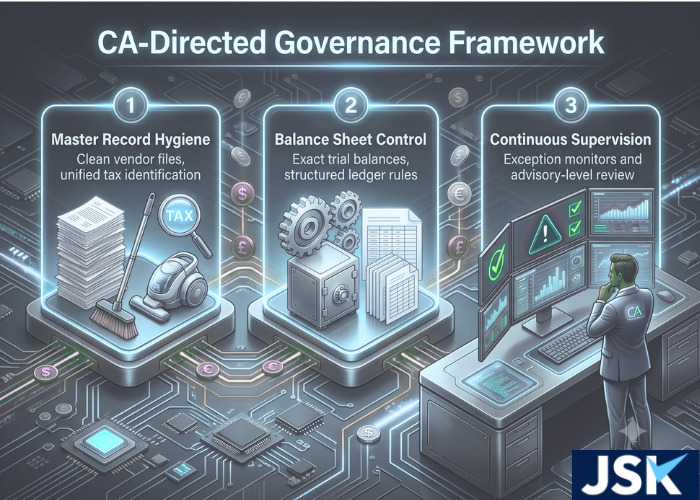
A CA-supervised ERP rollout anchors technical engineering directly to sound balance sheet accounting. Having finance professionals guide data mapping ensures that corporate tax rules, intercompany transfers, and statutory audit readiness are built into the system from day one.
Frequently Asked Questions
What constitutes a successful enterprise SAP modernization?
A successful modernization updates core enterprise architecture onto modern platforms like SAP S/4HANA while stripping away legacy technical debt. It turns overnight batch operations into real-time transactional visibility, embeds intelligent software agents into routine workflows, and unifies financial and operational performance metrics into a dependable single source of truth.
When should an enterprise favor a clean-core rebuild over an in-place conversion?
A clean-core rebuild makes the most sense when an organization is hindered by 15 to 20 years of custom patches, disorganized item catalogs, and an outdated general ledger structure. If your existing database configuration is clean, lightly customized, and requires uninterrupted access to historical records, an in-place conversion is generally the faster route.
How do autonomous software agents differ from traditional enterprise automation?
Traditional automation depends on strict "if-this-then-that" formulas that stall whenever data formats change or documents are incomplete. Autonomous software agents apply contextual reasoning to parse unstructured information, resolve complex operational exceptions, and coordinate multi-step resolutions across enterprise systems without constant human intervention.
Why is chartered accountant oversight necessary during system transitions?
Technology teams specialize in database throughput, network architecture, and code stability, but they are rarely trained in technical accounting rules. A CA-supervised approach guarantees that data transfers protect trial balance integrity, preserve general ledger accuracy, and maintain full statutory tax compliance throughout cutover.
Transforming Enterprise Operations with Krijay
Modernizing core enterprise systems offers zero tolerance for operational blind spots or accounting errors. When a migration is managed poorly, companies face delayed customer deliveries, broken inventory records, and regulatory friction. Pure software expertise is not enough; enduring operational resilience demands rigorous financial control, disciplined data mapping, and deep architecture experience.
Krijay is a dedicated, CA-supervised ERP implementation and operational transformation firm. Blending deep technical proficiency across SAP Business One and S/4HANA with rigorous accounting governance, Krijay designs transitions that serve genuine business and balance sheet goals.
Whether your company is mapping out an enterprise clean-core rebuild, reviewing active system health, or deploying autonomous software agents across your finance and procurement workflows, Krijay delivers:
- Disciplined Master Data Overhauls: Standardizing product catalogs, vendor records, and chart of accounts structures for reliable global operations.
- Reconciliation-Guaranteed Migrations: Protecting general ledger continuity, opening balances, and audit records through disciplined cutover methodologies.
- Strategic Financial Governance: Providing ongoing visibility through Virtual CFO advisory, automated exception alerts, and compliance-ready data structures.
For practical guidance on protecting your operational records during system shifts, review our roadmap on navigating migrations without data loss. To explore how our advisory team can structure your modernization journey, review our About Us page or discover our complete service offerings across our Home and Services pages.
Build your business on an audit-ready, high-performance operational foundation. Partner with Krijay to design an enterprise modernization strategy that delivers reliable, long-term scale.