
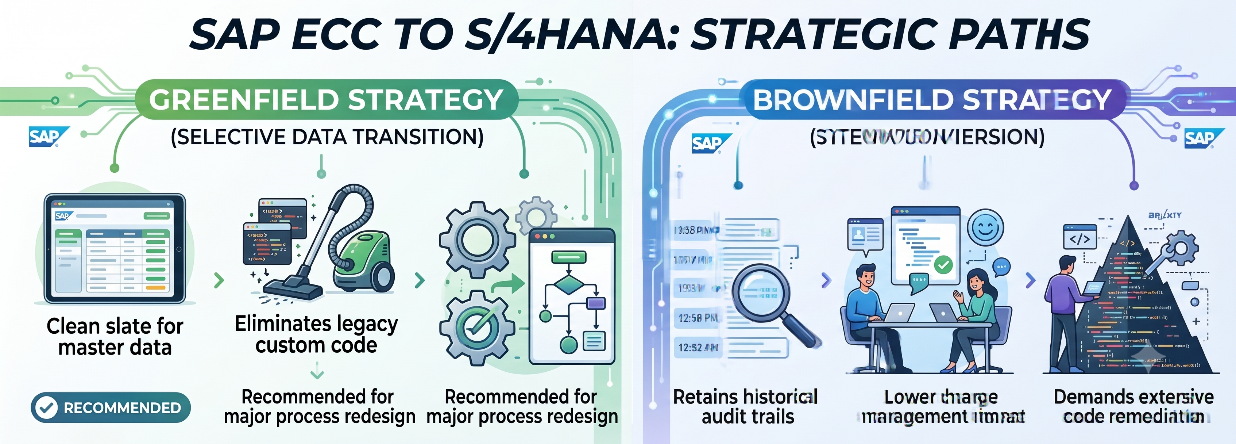
Greenfield and Brownfield migration paths create different trade-offs for validated pharmaceutical operations.
Introduction
Moving an active pharmaceutical manufacturing plant from legacy ERP to modern architecture is not an ordinary IT upgrade; it is open-heart surgery on live, regulated processes. With SAP ECC approaching the end of mainstream maintenance, mid-sized and large Indian pharmaceutical manufacturers must plan their transition to SAP S/4HANA.
In pharma, migration is never just about moving tables or updating code. A validation glitch during cutover can halt batch releases, invalidate audit trails, trigger inspection observations, or corrupt standard costing.
This guide explores what an SAP ECC to S/4HANA migration looks like when tailored to life sciences organisations. It covers architectural strategies, GST and e-invoicing reconciliation, regulatory validation under GAMP 5 and US FDA 21 CFR Part 11, Certificate of Analysis generation, and the emerging role of agentic AI in finance, collections, and supply chain operations.
Deconstructing the Migration Dilemma: Greenfield vs. Brownfield in Regulated Plants
Choosing how to transition systems determines the project's risk profile, budget, and validation timeline. For pharmaceutical firms operating under regulatory frameworks such as US FDA, WHO-GMP, and EDQM, the choice between a clean slate and an in-place conversion comes down to regulatory risk management.
Greenfield Implementation (Selective Data Transition)
A greenfield approach involves deploying a clean SAP S/4HANA environment and transferring only cleansed, relevant master data and opening balances.
The advantage for pharma: Legacy SAP ECC instances often accumulate heavy customisation, obsolete Z-tables, and duplicate vendor or raw-material codes. Greenfield allows businesses to eliminate technical debt, redesign the chart of accounts, and adopt standard SAP industry processes.
The regulatory consideration: Because historical batch master data, inspection lots, and executed electronic batch records remain in the legacy repository, companies must maintain validated, read-only archives to fulfil record-retention obligations.
Brownfield Implementation (System Conversion)
A brownfield conversion updates an existing SAP ECC system to SAP S/4HANA in place, preserving database history, master records, and established transactional workflows.
The advantage for pharma: Historical continuity is preserved. Past inspection records, equipment calibration histories, and historical financial movements remain accessible without complex data-extraction projects.
The regulatory consideration: Custom ABAP code, interfaces, and legacy user exits must undergo code remediation for compatibility with the HANA database and S/4HANA simplification items. Unchecked legacy scripts can undermine system stability or bypass required electronic signatures.
| Migration Vector | Greenfield Implementation | Brownfield Conversion |
|---|---|---|
| Data Cleansing Effort | High: requires a complete master-data overhaul | Low to moderate: data is cleaned in place |
| Historical Batch Records | Kept in a validated read-only archive | Preserved directly within active tables |
| Custom Code (Z-Objects) | Discarded in favour of clean-core standards | Remediated and adapted for HANA compatibility |
| Validation Timeline (CSV) | Comprehensive revalidation across all modules | Delta validation focused on changed workflows |
| Go-Live Cutover Window | Highly controlled cutover weekend | Requires iterative downtime optimisation |
GAMP 5, US FDA 21 CFR Part 11, and Master Data Integrity
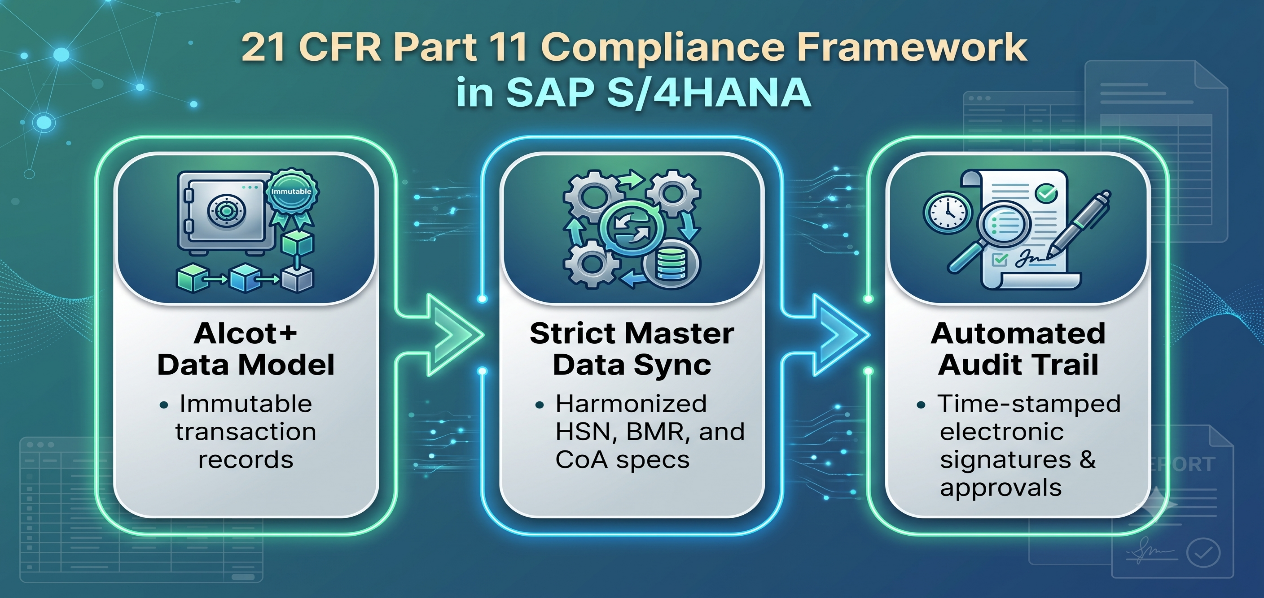
In the pharmaceutical sector, data integrity is a clinical and legal requirement. Under US FDA 21 CFR Part 11 and EU Annex 11, digital records require controlled electronic audit trails, signature controls, and safeguards that support data integrity.
Electronic Signatures and Audit Trails
SAP S/4HANA provides centralised change-document capabilities and controlled approval workflows. During an ECC migration, engineering teams must ensure that digital signatures used in production - including batch disposition, master recipe approvals, and material sampling in Quality Management - create attributable, time-stamped records that support ALCOA+ data-integrity principles.
Item Master, HSN, and Bill of Materials Cleansing
A formulation plant may maintain hundreds of raw materials, including active ingredients, binders, excipients, and primary barrier foils, each governed by storage grades and vendor monographs. In legacy systems, identical chemicals can exist under multiple material codes, distorting inventory valuations and creating ambiguity during compounding.
Migrating to S/4HANA requires teams to reconcile item master records by:
- Standardising units of measurement across laboratory and shop-floor teams.
- Aligning Harmonised System of Nomenclature codes for Indian GST calculations.
- Structuring multi-level bills of materials so changes in raw-material potency can adjust recipe allocations.
Quality Management: Automating CoA Generation and LIMS Integration
A recurring operational bottleneck in Indian pharmaceutical manufacturing is the manual preparation of Certificates of Analysis and reliance on disconnected Laboratory Information Management Systems.
Direct LIMS Integration with SAP S/4HANA QM
Modern pharmaceutical supply chains cannot afford the latency of manually entering results from laboratory instruments into an ERP. In SAP S/4HANA Quality Management, an integrated process can provide:
- Automated inspection lots: When raw materials arrive, an inspection lot is generated and the material is placed into quality-inspection stock.
- Bidirectional LIMS synchronisation: Results from instruments such as HPLC, GC, and spectrophotometers can pass securely to SAP S/4HANA, reducing transcription errors and uncontrolled post-hoc alterations.
- Automated usage decisions: When validated parameters fall within approved tolerances, configured workflows can support the usage decision and stock release.
Automated Certificate of Analysis Generation
Manual Certificate of Analysis generation introduces compliance risks, including incorrect batch references, assay transcription errors, and missing stability-testing data.
Within SAP S/4HANA, a controlled CoA process can pull approved test results from inspection records and compare them with customer-specific or pharmacopeial specifications such as USP, BP, and IP. The system can then compile the Certificate of Conformity or CoA as a controlled PDF with the appropriate approval and verification mechanisms.
Indian Statutory Compliance: GST, E-Invoicing, and Financial Reconciliations
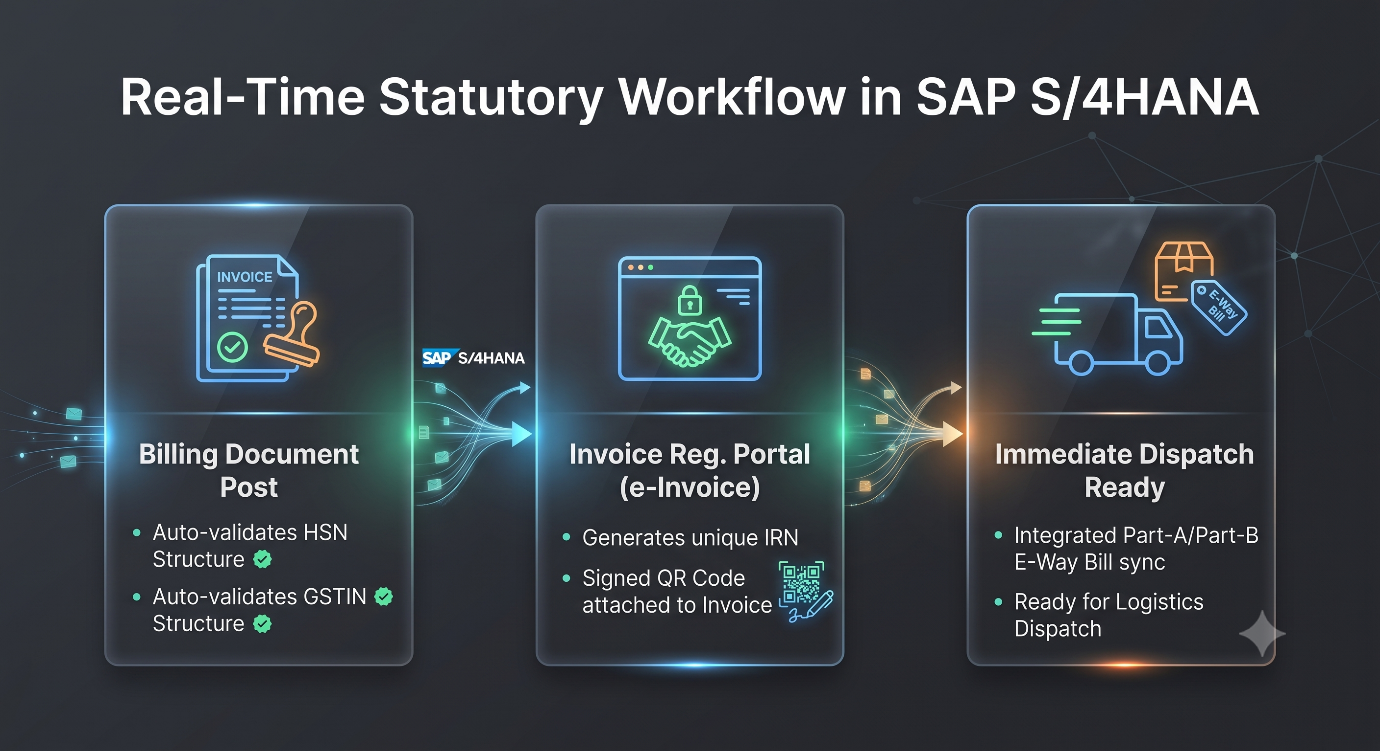
A critical area where generic implementations can fall short is Indian statutory compliance. Pharmaceutical companies with manufacturing units in Hyderabad and distribution across multiple states must manage GST rules, e-invoicing requirements, and logistics documentation.
Automated E-Invoicing and E-Way Bill Integration
For compliant pharma operations, outbound shipments cannot remain at factory gates waiting for manual documentation. A configured SAP S/4HANA workflow can:
- Transmit the required billing payload through an authorised GST Suvidha Provider to the Invoice Registration Portal.
- Retrieve the Invoice Reference Number and signed QR code for inclusion on the invoice.
- Coordinate e-way bill information with physical logistics to reduce dispatch delays.
Input Tax Credit Protection through GSTR-2B Reconciliation
Pharmaceutical companies procure large quantities of packaging materials, raw chemicals, and capital machinery. Unreconciled input tax credit can tie up significant operating capital.
During an ECC-to-S/4HANA migration, the financial architecture should reconcile purchase registers against incoming GSTR-2B data. Exception workflows can identify invoices from non-compliant vendors, helping finance teams protect working capital and resolve tax discrepancies before filing.
The New Enterprise Frontier: Agentic AI in Finance, SCM, and SAP TCoE
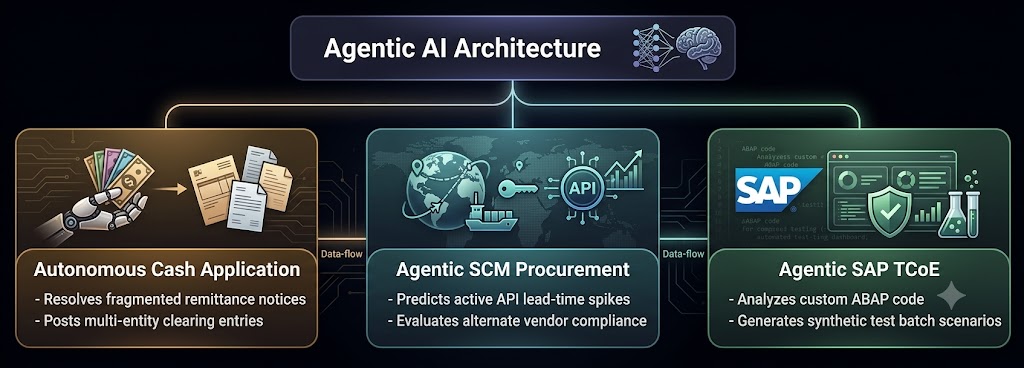
Digital transformation has moved beyond simple robotic process automation and static workflow rules. Enterprise leaders are exploring agentic AI: goal-driven agents designed to reason, orchestrate cross-system tasks, and handle operational exceptions within governed SAP environments.
Autonomous Finance Collections and Cash Application
Pharmaceutical organisations often struggle with fragmented cash visibility across bank accounts, currencies, and corporate entities. In legacy operations, credit controllers may spend substantial time matching lump-sum transfers against many open hospital and distributor invoices.
Autonomous reasoning: An agentic finance workflow can scan incoming bank feeds, ingest unstructured payment remittance advice, and analyse deductions, short payments, and TDS calculations.
Closed-loop action: Subject to configured controls and human approvals, the workflow can match line items to open receivables, prepare clearing entries for SAP S/4HANA's universal journal, and draft a dispute inquiry for unexplained short payments.
Source-to-Pay and Supply Chain Disruption Management
Active Pharmaceutical Ingredient supply chains are volatile. Port delays, environmental shutdowns, or regulatory holds can leave production lines short of precursor chemicals.
An agentic procurement workflow can monitor external risk signals, supplier delivery scores, and inventory buffers in S/4HANA. If a critical shipment is delayed, it can assess approved alternatives from the Qualified Vendor List, verify available compliance data, calculate the production impact, and draft a purchase order for review.
Agentic AI-Powered SAP Testing Center of Excellence
Ongoing regression testing and validation are major components of SAP lifecycle management whenever regulatory patches or updates are applied.
Governed AI agents can inspect system logs, evaluate modified ABAP routines, and map business-impact areas across sales, finance, and quality management. They can also help construct test cases, execute approved synthetic batch transactions, verify audit-trail completeness, and prepare test evidence for human review and sign-off.
Conclusion: Partnering with Krijay for Resilient, Financially Sound Modernisation
An SAP ECC to S/4HANA migration in a regulated pharmaceutical market leaves little margin for technical error or financial oversight. When transformations stumble, organisations can face stockout penalties, delayed shipments, unreconciled ledgers, and compromised regulatory standing. Technology configuration alone cannot safeguard the enterprise; operational transformation must be grounded in accounting control, regulatory insight, and practical industry experience.
Krijay bridges this gap as a specialised, CA-led ERP implementation and digital transformation partner. Combining SAP architectural capability across SAP Business One and S/4HANA with chartered accountancy oversight, Krijay treats each enterprise rollout as a financial and operational transformation.
Krijay supports pharmaceutical organisations with:
- Master data cleansing: Harmonising item masters, the chart of accounts, and vendor records for regulatory and tax compliance.
- Controlled migrations: Protecting trial balances, approved opening values, and operational continuity across cutover milestones.
- Virtual CFO and advisory services: Providing financial governance, exception reporting, and executive-level visibility.
Modernise your enterprise operations on a stable, compliant foundation.
Discuss your SAP S/4HANA pharma migration
Frequently Asked Questions
What is the primary difference between a Greenfield and Brownfield SAP ECC to S/4HANA migration for pharma?
A Greenfield migration rebuilds the ERP landscape in a clean environment, allowing a pharmaceutical company to remove obsolete custom code, redesign the chart of accounts, and enforce standard master-data structures while archiving historical batch records. A Brownfield migration converts the existing SAP ECC system in place, preserving historical transactions, batch data, and validation records, but requires custom-code remediation for the HANA database.
How does SAP S/4HANA support US FDA 21 CFR Part 11 and GAMP 5 compliance?
SAP S/4HANA provides capabilities that can support controlled audit trails, digital signatures, and role-based authorisation. Compliance depends on the complete validated solution, including configuration, procedures, testing, access controls, training, and operating discipline under the organisation's applicable GAMP 5 and regulatory framework.
Why is a CA-led approach important during an ERP migration for Indian manufacturers?
A CA-led ERP implementation places accounting logic, balance-sheet accuracy, trial-balance reconciliation, input-tax-credit controls, and Indian GST requirements alongside technical conversion and integration work. This helps reduce reporting discrepancies, financial mismatches, and compliance failures after go-live.
How does agentic AI interact with SAP S/4HANA in supply chain and finance operations?
Unlike static scripts, agentic AI uses goal-oriented reasoning to coordinate multi-step tasks. With appropriate governance and approvals, it can work through SAP S/4HANA APIs to interpret payment remittances, prepare receivables matches, monitor supply-chain risk, propose inventory actions, and assist with regression testing.