
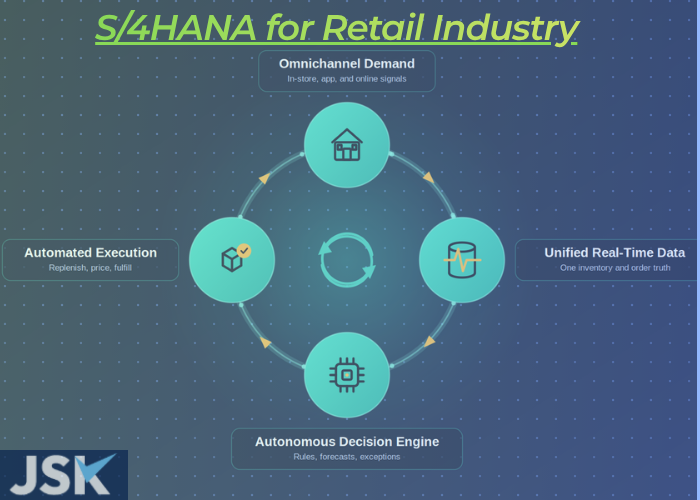
Connected demand, inventory and governed automation form the operational foundation of an autonomous retail enterprise.
Introduction
We have sat through enough SAP roadmap sessions to develop a healthy allergy to the phrase "autonomous enterprise." It gets dropped into slide decks like a complete strategy, but the practical meaning is often left unexplained. When retail clients started asking what SAP actually means by it, we decided to pull the term apart rather than repeat it.
This is not a marketing recap. It is our view of what changes when SAP S/4HANA for retail moves beyond recording transactions and starts helping teams detect conditions, recommend actions, and automate selected decisions across stores, fulfilment, inventory, and merchandising.
What "Autonomous Enterprise" Actually Means
SAP describes the Autonomous Enterprise as a combination of connected business data, governed AI, and applications that run more processes autonomously. In practical retail terms, routine decisions - such as replenishment calculations, exception handling, forecasts, and selected pricing actions - can be supported or executed by software within controls defined by the business. Human judgment remains focused on exceptions and decisions with material commercial consequences.
That distinction matters because retail produces a very high volume of repeated decisions. Every product and location generates fresh questions about what to reorder, what to allocate, which exception to investigate, and when a promotion or markdown needs attention. Many of those decisions follow known policies, tolerances, and approval rules.
The shift represented by S/4HANA for retail is from a system that mainly records what happened toward an operational platform that can initiate controlled action. The goal is not "AI runs the business." It is an exception-driven operating model in which people set policy, supervise outcomes, and handle ambiguity.
Why Retail Is a Proving Ground for This Idea
Retail combines three difficult constraints: margin that can disappear when markdown timing is wrong, fragmented customer channels that must share consistent information, and demand that can change quickly because of weather, festivals, promotions, or competitor activity.
Traditional retail systems often handled these pressures through safety stock, periodic batch updates, spreadsheets, and manual overrides. That becomes harder when one inventory pool must support stores, mobile apps, marketplaces, call centres, click-and-collect, and home delivery at the same time.
SAP's retail portfolio addresses these problems through retail merchandise management, SAP Customer Activity Repository, inventory visibility, unified demand forecasting, merchandise planning, omnichannel promotion pricing, replenishment, and allocation. The precise combination depends on the retailer's landscape and licences; these capabilities should not be treated as one automatic feature switch.
The case is especially relevant in India, where organised retail, direct-to-consumer brands, quick commerce, GST compliance, and omnichannel fulfilment are evolving together. A dependable retail ERP foundation helps a retailer make credible availability and delivery promises across stores, warehouses, and dark-store networks.
The Building Blocks: How S/4HANA Enables Retail Operations
Set the buzzword aside and four practical building blocks emerge.
Unified Commerce and a Shared View of Demand
SAP Customer Activity Repository provides a harmonised multichannel transaction model that can consolidate customer and transactional activity from stores and digital channels. Its inventory visibility and omnichannel availability capabilities help consuming applications provide consistent availability and sourcing information across channels.
When demand and availability are governed on shared data, replenishment, allocation, pricing, and fulfilment can work from a more consistent operational picture instead of separately reconciled extracts.
Demand-Driven Replenishment and Allocation
SAP S/4HANA retail supports demand-driven store replenishment and merchandise allocation processes. Depending on the configured process, the system can calculate requirements from inventory and demand information, generate follow-on procurement documents, and automate activities within defined policies.
A planner can concentrate on unusual demand, constrained supply, or exceptions outside tolerance rather than manually reviewing every routine line. SAP Integrated Business Planning can complement this landscape where advanced planning capabilities are required.
Embedded AI for Exception Management
Joule and SAP Business AI can bring context-aware assistance and agentic workflows into SAP processes. The practical near-term opportunity is not unsupervised retail management; it is faster investigation and response when an exception occurs, with authorised actions, escalation rules, and an audit trail.
Near-Real-Time Inventory Visibility
SAP Customer Activity Repository inventory visibility can combine ERP inventory information with unprocessed point-of-sale activity to provide a clearer current inventory position. Its omnichannel availability and sourcing functionality is designed to provide consistent information for stores, online, mobile, and call-centre channels.
This shared visibility is a prerequisite for reliable click-and-collect promises, cross-channel fulfilment, and automated replenishment. Actual freshness and accuracy still depend on integration design, transaction feeds, master data, and operational discipline.
What Changes on the Ground?
Consider a regional apparel retailer with fifty stores and an online channel. Before transformation, merchandisers may review reorder suggestions every morning, another team may allocate online inventory using delayed store data, and markdown decisions may follow a weekly calendar rather than actual sell-through.
After a well-run S/4HANA retail implementation, routine replenishment proposals can be processed within tolerance bands, store and digital channels can consume a shared availability view, and exceptions can surface when sell-through or supply conditions move outside policy.
The job does not simply disappear; it changes. Planners spend less time moving data and more time defining rules, reviewing exceptions, tuning thresholds, and handling genuinely ambiguous commercial decisions. That operating-model improvement is often more important than a generic automation percentage.
The Honest Caveats
Automation Is Only as Good as the Data
If store-level inventory is wrong, automated replenishment can repeat the mistake faster. Product, location, supplier, pricing, and inventory data need clear ownership and cleansing before go-live. Data governance is usually one of the least glamorous and most underestimated parts of a retail transformation.
Guardrails Need Named Owners
Every automated replenishment, allocation, or pricing rule needs an accountable owner. Tolerance bands, approval limits, access controls, monitoring, and exception thresholds should reflect the retailer's risk appetite and be reviewed as the business changes.
Change Management Is an Operating Requirement
This is not only a software change. It alters what planners, store teams, and merchandisers do each day. Retailers that treat the programme as a purely technical rollout may get the system live without changing decisions or realising the expected value.
How Krijay Fits Into This
At Krijay, we help retail businesses move to S/4HANA with the data governance, process design, integration, controls, and change management built into the plan. The important work is in closing the gap between the promise of an autonomous enterprise and what reliably operates on a store floor.
Whether you are evaluating a first move to S/4HANA for retail operations, comparing cloud transformation approaches, or trying to get more value from an existing landscape, we start with the specific operational problems: inventory accuracy, replenishment logic, fulfilment promises, exception ownership, and adoption by the teams who run the business.
Discuss your retail transformation
Frequently Asked Questions
What does "Autonomous Enterprise" mean in SAP S/4HANA?
It describes an operating model in which connected data, governed AI, and business applications help execute more routine processes autonomously. In retail, this can include replenishment, exception handling, forecasting, and selected actions performed within rules and approval controls set by the business.
Is S/4HANA suitable for retail businesses?
Yes. SAP S/4HANA Retail for merchandise management supports end-to-end retail processes, and SAP's wider retail portfolio adds capabilities for multichannel transactions, inventory visibility, demand forecasting, planning, pricing, replenishment, and allocation. The right scope depends on the retailer's channels, scale, process complexity, and existing systems.
How does SAP support omnichannel retail operations?
SAP Customer Activity Repository provides a harmonised multichannel transaction foundation. Its inventory visibility and omnichannel availability and sourcing capabilities can supply consistent information across stores, online, mobile, and call-centre channels when the underlying integrations and data feeds are correctly implemented.
What is the difference between RISE with SAP and SAP S/4HANA Cloud?
SAP S/4HANA Cloud is the cloud ERP software. RISE with SAP is a transformation offering that can package SAP S/4HANA Cloud Private Edition with infrastructure, services, tools, and lifecycle support. Commercial scope and included services depend on the contract and edition.
How long does an S/4HANA implementation take for a retailer in India?
There is no universal timeline. Store count, legal entities, channels, integrations, localisation, data quality, process standardisation, rollout strategy, and change readiness all affect duration. A reliable estimate should follow discovery and data assessment rather than a generic industry range.